

Does Home Insurance Cover Fire Damage? What Policyholders Should Know 🏠🔥
Imagine watching years of hard work and memories vanish into ash and acrid smoke in a matter of minutes. However, for many Florida property owners, the true nightmare doesn’t begin with the flames—it begins when the fire trucks leave and the insurance bureaucracy takes over. While the fundamental answer to the question does home insurance cover fire damage is technically “yes,” the financial reality is dictated by the fine print, complex depreciation schedules, and the insurer’s aggressive tactics to minimize their liability. In a high-stakes environment like Hollywood, Florida, mastering the mechanics of your policy is the only way to transform a lowball offer into a fair recovery.
📈 Hidden Destruction and the True Scale of Fire Perils 🧐
A residential fire is far more than just what the flames touch. In South Florida’s humid climate, the secondary effects of a fire can be more destructive to the building’s core than the initial ignition point. Insurance carriers often focus only on visible charring, intentionally overlooking structural compromises and chemical residues that will manifest as health hazards months down the line.
- 💨 Toxic Soot and Particulate Infiltration: Microscopic soot particles are highly acidic. If they are not professionally neutralized, they will continue to corrode electronics, appliances, and even the internal steel reinforcement of concrete structures.
- 💧 Hydraulic Impact and Chemical Residue: The thousands of gallons of water used by fire departments create an immediate risk of catastrophic mold growth, which spreads rapidly in the Florida heat.
- ⚡ Thermal Weakening: Extreme heat can strip materials of their structural integrity without showing a single burn mark. Drywall, roofing trusses, and window seals often lose their functional rating after exposure to high temperatures.
- 🌫️ HVAC System Contamination: Smoke travels through wall cavities and settles inside ductwork. Simple cleaning is rarely enough; often, the entire system must be replaced to ensure the air remains breathable.
Professional advocacy is essential here. Firms like Base Claims Public Adjusters are trained to identify these invisible costs, ensuring that the insurance company pays for a total restoration rather than a superficial “clean and paint” job.
📋 Critical Defensive Steps for Your Insurance Recovery ✅
Time is your greatest enemy following a fire loss. To secure a settlement that actually covers the cost of rebuilding in today’s expensive construction market, you must follow a rigid evidence-gathering protocol. In affluent areas like Hollywood, even a small documentation error can lead to a significant underpayment of the claim.
- 📍 Emergency Mitigation: You have a contractual duty to prevent further damage. This involves boarding up the property and tarping the roof immediately to prevent rain from destroying what the fire spared.
- 📍 Preservation of Debris: Do not throw away damaged items. Even a pile of burnt debris serves as vital evidence of the quality and value of your lost possessions.
- 📍 Policy Audit: Secure a full copy of your “Certified Policy.” You need to know if you have “Replacement Cost Value” (RCV) or “Actual Cash Value” (ACV), as this determines the payout logic.
- 📍 Additional Living Expenses (ALE) Tracking: If your home is uninhabitable, keep a meticulous record of every meal, hotel stay, and mile driven. This is a separate bucket of money that insurers often try to limit.
If you find that your carrier’s adjuster is ignoring these complexities or pressuring you to sign a release early, it is time to shift the leverage in your favor.
🛠️ The Invisible Threat of Smoke and Chemical Residue 🌫️
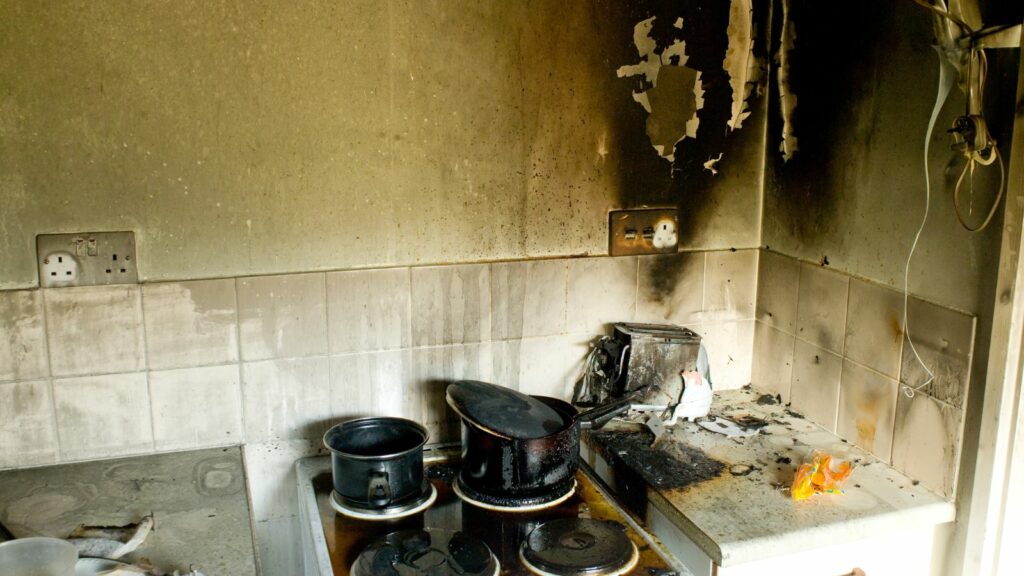
One of the most frequently denied aspects of a fire claim is the comprehensive remediation of smoke odor and acidic soot. Insurers often argue that a simple ozone treatment or a fresh coat of “odor-blocking” paint is sufficient. However, smoke is a physical substance that permeates insulation, porous wood framing, and even electrical outlets. If these particles are not removed, the smell of the fire will return every time your HVAC system cycles or the humidity rises.
This deep-seated contamination is a primary reason why many fire damage claims are undervalued. Carriers rely on the homeowner’s lack of technical knowledge regarding “thermal expansion,” which allows soot to drive deep into surfaces while they are hot. Base Claims Public Adjusters utilizes forensic testing and industrial hygiene reports to prove the presence of these toxins, forcing the insurer to cover the cost of professional-grade abatement rather than a cosmetic fix.
⚠️ Navigating the Pitfalls of Fire Claim Settlements 📉
Insurance companies are profit-driven corporations, and their adjusters are trained to find “pre-existing conditions” or “wear and tear” as reasons to slash your estimate. They rely on the fact that most homeowners are too overwhelmed to challenge their complex math or their insistence on using “preferred vendors” who work for the carrier’s benefit.
When you are managing the aftermath, your only real defense is comprehensive documentation. This includes independent laboratory reports, detailed line-item estimates, and evidence of local labor costs. If you feel your water damage insurance claim (from fire suppression) is being unfairly minimized or your fire loss is being treated as a minor repair, hiring a professional advocate is a necessity. A public claim adjuster works exclusively for you, ensuring the policy language is used as a shield for your assets, not a weapon for the insurer’s bottom line.
Email [email protected]
Phone +1 (954) 466-5730
Office: 954-466-5730
Website https://www.baseclaims.com/